



RETSD CODE OF CONDUCT
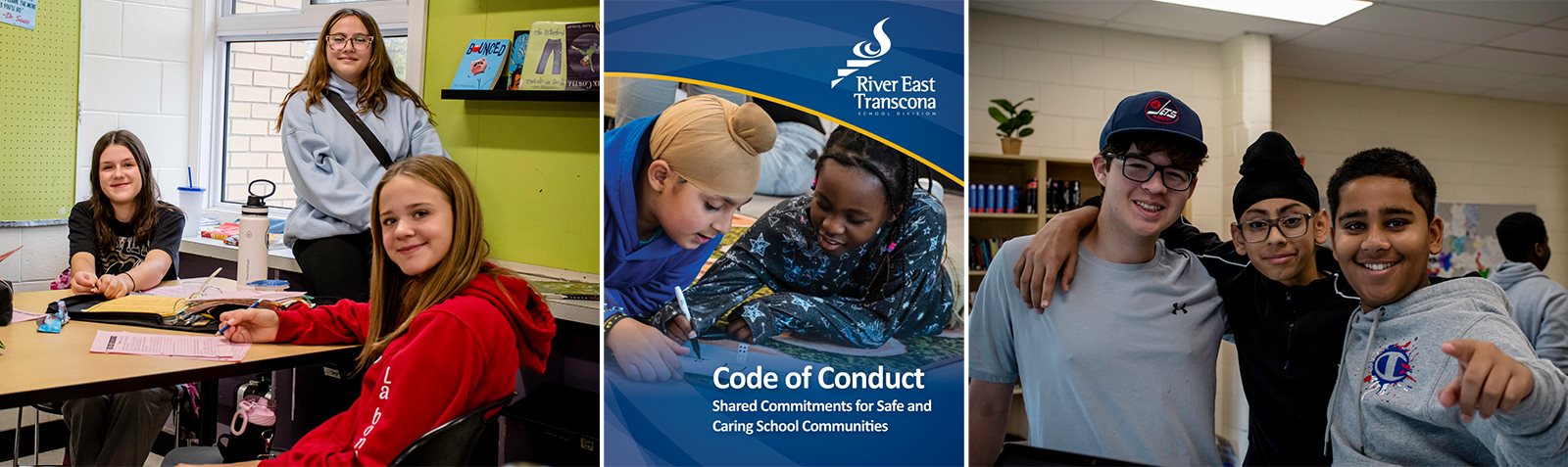
RETSD has a divisional code of conduct policy document that outlines shared commitments for building safe and caring school communities. It provides details about the roles and responsibilities of administrators, teachers, students, and families – and outlines how we intervene when a student engages in unwanted behaviour such as being aggressive toward other students or staff, discriminating against others, using illegal substances, or engaging in gang activity on school sites.
Parents and caregivers are encouraged to review the Code of Conduct: Shared Commitments for Safe and Caring School Communities with their students at the start of each academic year:
RETSD’s Code of Conduct policy echoes Manitoba Education and Early Childhood Learning’s Safe and Caring Schools — Provincial Code of Conduct. The provincial and divisional codes emphasize using positive interventions early in a student's journey in order to encourage development of the behaviours needed for learning, growth, self-regulation, and conflict resolution. Promoting and teaching positive and safe ways of handling difficult emotions and situations will also help to keep staff and students safer.
Using disciplinary methods such as timeouts, loss of privileges, working in alternate locations, suspensions, and expulsions are still options when necessary. However, constructive measures such as meetings between a student and trusted adult, positive behaviour agreements, self-regulation teaching and supports, restitution for damages, and referrals to student services personnel or outside agencies are used first. This reduces the need for discipline methods that result in a student missing school.
References
• The River East Transcona School Division Policy Manual
• The Provincial Code of Conduct
• The Safe Schools Charter of Manitoba
• Mamàhtawisiwin: The Wonder We Are Born With – An Indigenous Education Policy
• Safe and Caring Schools — Provincial Code of Conduct
• Standards for Appropriate Educational Programming
Applicable Policies Include:
• Policy ACF—Respect for Human Diversity
• Policy BEDH—Public Participation at Board Meetings
• Policy IJND—Instructional Technology Use
• Policy JB-R—Appropriate Educational Programming Student-Specific Planning
• Policy JICA—Student Dress Code
• Policy JICDAC—Assessment of Risk to Others
• Policy JICH—Alcohol and Other Drug Use by Students
• Policy JICJ—Student Use of Student Supplied Electronic Devices
• Policy JKD—Student Suspension and Expulsion
• Policy KE-R—Concerns and Complaints Procedures
• Policy JICDAB—Freedom from Bullying
• Policy JICI—Weapons
• Policy JICI-E1—Definitions for Weapons Policy
• Policy JKD—Student Suspension and Expulsion
• JICG—Electronic Vaporizer
• IFCA—Indigenous Education
• JB—Appropriate Educational Programming
